Sita Sings the Blues
If you are planning to visit India, I have lots of resources right here on Breathedreamgo. Start by reading the following blogs: Advice for first time travelers, Top 5 Myths about India, Avoiding bed bugs, bacteria and bad guys, Top 5 things I’ve learned after a year of travel in India , Top 10 tips for women traveling in India and my Packing list for India. And don’t miss watching How to use an Indian toilet – it’s a funny and informative video by the great Wilbur Sargunaraj that will teach you a very important, essential skill.
I would also recommend reading about India. I have included a list of 10 books about India that I love, and 10 more books, and a list of spiritual books that I love, some of which are pertinent. Of course, there are loads more I haven’t read or even heard of — so let me know if you come across something good. (more…)
I love taking the train in India. It’s a great way to see the country, meet people and generally slow down your trip. Indian Railways is the world’s largest employer and the train system is massive and complex. You can book online on the IRTCT site and find great tips on Figuring out India Rail Travel on the wonderful The Planet D site.
I have many memories of watching India’s sun-baked landscape slide by, but here are two of my favourite train ride stories. (more…)
[Note: Originally published as Recommended: Travel solo in India by Solotravelerblog.)
When I was 45 years old, I put everything I owned in storage, gave up my apartment and went to India for six months. It was the first time in my life that I had done anything like this. But it was time. I had always wanted to go to India and, after losing both of my parents, I knew it was now or never to go after my dreams.
Was I scared? You bet. But it was the “healthy” kind of scared – the kind that rises up from within and first whispers, then roars: if you overcome this, you will be forever changed. So I went. I jumped off the proverbial cliff to see how the universe would respond.
[NOTE: Originally published on Journeywoman, July 2009.]
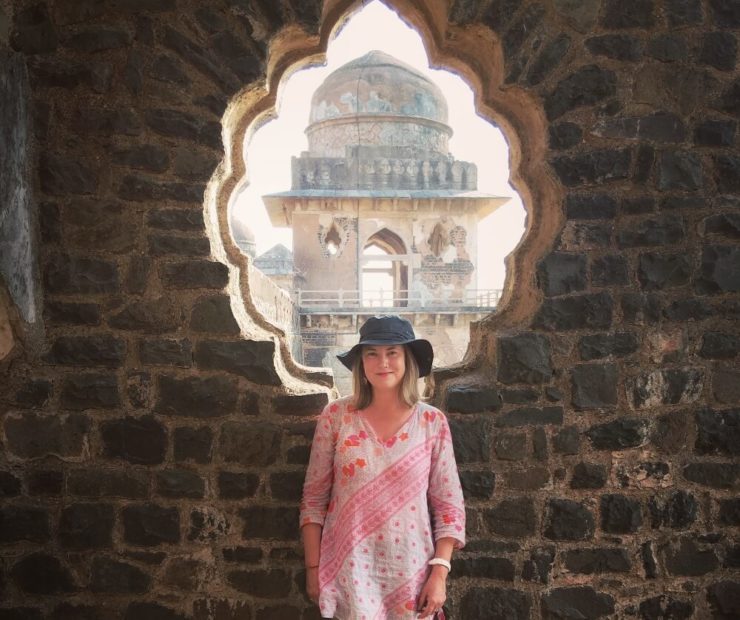
Moi, in salwar kameez, at Kanyakumari - the very southern tip of India
Aside from good walking shoes and sandals, a one-piece bathing suit and cotton bras and underwear – or, if you prefer, the synthetic kind that wicks away sweat – don’t bring any clothes to India. If you land in Delhi, head straight to one of the Fabindia outlets and stock up on inexpensive cotton “suits.” The three-piece suit (in Hindi, salwar kameez) consists of a long or short tunic over fitted or wide-legged pants, topped with a long scarf, called a dupatta. These outfits suit the climate, the need for modesty and will help you fit in, mitigating your status as a moving target for gawkers, touts and beggars.

Temple bell, cow, temple, Pushkar
I am flagrantly copying a fantastic Travel Advisory I saw on Rebel’s blog — but I have adapted it for travel in India. (Thanks Rebel — imitation is the sincerest form of flattery!) Next time I am traveling and blogging in India, I will code each entry with one of the following:
Temple bells – At one with the universe. Content, happy, going with the flow.
Mango lassi -- Fun times! Having adventures, going to festivals, celebrating.
Masala chai – Situation normal. Feeling at home with friends. All is well.
Veg or non-veg thali – The challenge of culture shock is noticeable, but I’m taking it in stride.
Bhel puri – One too many people tried to sell me something, over-charge me, beg money from me or talk to me in a way that does not uphold “Aththi Devo Bahv.” Wishing I was invisible.
Chili peppers -- Arrggghh, too many people, too hot, too noisy, too polluted, I need sanctuary!

Moi, with friends, at the Taj Mahal
- Go to the Taj Mahal. Yes, it’s worth it. It may be one of the few times in your life when all the hype and hyperbole actually fails to capture the spectacular beauty of the real thing.
- Take the train. Traveling by train in India is an adventure. Indian Railway is the world’s biggest employer (1.2 million employees) and everyone takes the train, from ministers to farmers. It takes a bit of time to master the class system (2AC is a good choice); the new online ticket system really helps. You will meet lots of friendly people, no matter which class you travel.
- Learn a few words of Hindi. Most educated people speak English, but working class people and villagers rarely speak more than a few words. “Namaste” is a common greeting; “theek hai” is okay; “accha” is, is that right?; “jaao” is go away’ “chai” is tea; “paani” is water.
A while I ago, I wrote a blog post that listed my Top 10 Books on India (thus far). This is the second installment in my series, Books I love about India.
1. Kim by Rudyard Kipling. It’s a masterpiece. I read it with my jaw on the floor. I have been reading for, oh, 43 years, give or take, and I have never read a book that is so in the moment. You tramp along with Kim down the streets of Lahore, on the Grand Trunk Road, through Himalayan passes. Every sound, every smell, every gesture, every accent is evoked. The dust swirls around you, the smell of cooking food entices you, the fresh air of the mountains revives you. Kipling knew the road in India, and he knew how to capture it in words. And Kipling is not just a master of description — he is a master story-teller. Like India herself, this story is bold, complex, subtle and ambiguous. Though it is not an easy read, it is hugely rewarding. I will be reading it again soon.

I enjoyed reading Christine Garvin’s article, Can You Develop Your Spirituality Without Visiting India? on Brave New Traveler (part of the Matador Travel Network).Of course, I whole-heartedly agree that finding or increasing your spiritual awareness is not about location. Spirituality is an attitude and an understanding. You can find it, learn it or increase it anywhere and anytime. In fact, the lessons often come from the unlikeliest people and places. You don’t even have to go to a temple, church, mosque, gurdwara, mediation centre, ashram, monastery or what have you. Once you begin to see the world from a spiritual perspective, you may never need a formal teacher again.
Originally published in Dreamscapes magazine.

View of the majestic Himalayas from Anand Prakash Yoga Ashram
As I sit writing this on the balcony of my room at the Anand Prakash Yoga Ashram in Rishikesh, India, the melodious sound of people singing kirtan (devotional songs and chants) floats up from the yoga hall below. From here, I have a breath-taking view of the imposing foothills of the Himalayas and I can feel the invigorating mountain air as it sweeps into this serene valley, through which the jewel-green Ganga (Ganges) River flows. It is easy to see why legend refers to the Himalaya range as Dev Bhoomi, land of the gods.
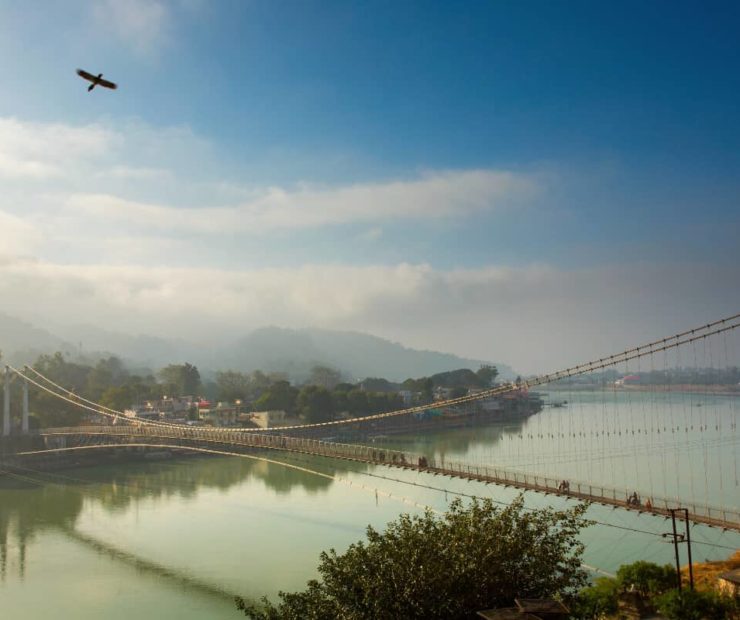
Rishikesh is a small and relatively (by Indian standards) peaceful town that meanders along the narrow valley on both sides of the Ganga, connected by two impressive suspension bridges, Laxman Jhula and Ram Jhula, which are open for pedestrian traffic, bicycles and motorcycles only. Seers – rishis – and sages have been gathering here, at this picturesque spot on the Ganges, since before recorded history to prayer, chant and meditate. Indian pilgrims and foreign yoga students alike flock here to stay in one of the town’s many ashrams and soak up the devotional vibes. It is often referred to as the yoga capital of the world.
Travel light and right
We all have small secret areas of expertise, and one of mine is packing for India. I am claiming this expertise based on three facts:
1) I have packed to go from my country (Canada) to India five times,
2) I did a LOT of research before I left on my first big, six-month trip to India — and brought a LOT of stuff I never used,
3) I have packed for about a 20-25 domestic trips within India in the many months (more than a year) I have spent in the country.
So, if you will accept my qualifications, you can confidently print this list before you go. Even in the few years I have been traveling to India I have noticed you can get more and more of the things we North Americans have come to depend on. But there’s still a few things you probably want to have in your backpack — yes, backpack — just in case.