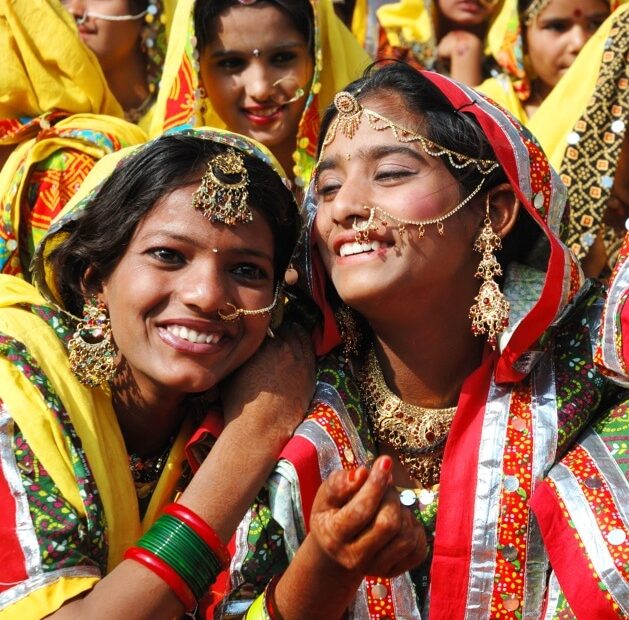
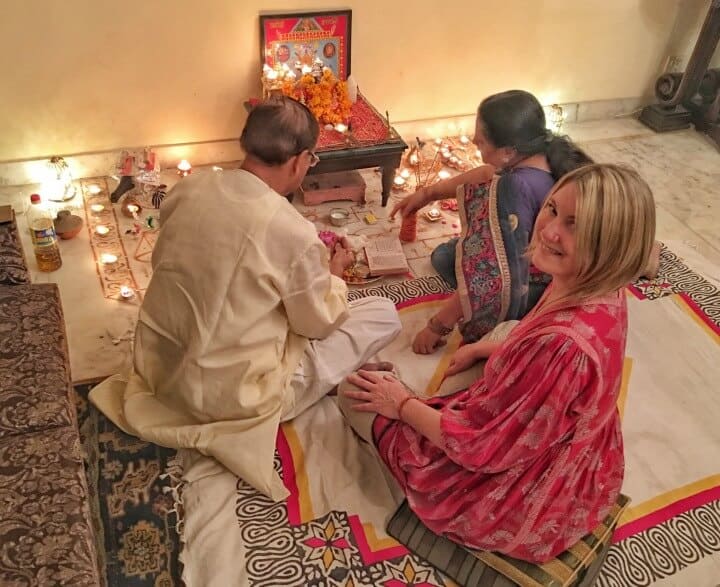
And girls all over the world, too. I’m participating in The Girl Effect blogger challenge — which is about raising awareness of the challenges girls face around the world. In India, my area of specialty, girls are often not educated; there are far more illiterate girls than boys; and girls are often forced into marriage. Yet, girls (and women) hold the key to an improved life for their families and communities. It has been proven that educated girls bring a lot more wealth and a higher standard of living and health into their communities.
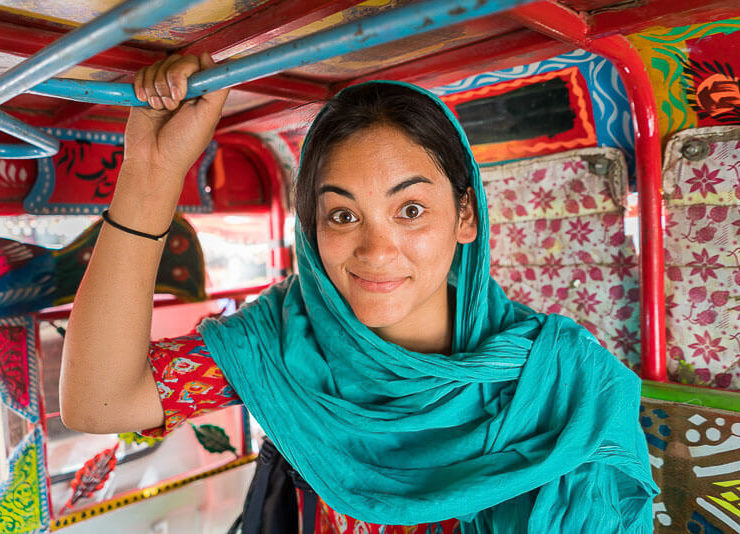
All over India I have met beautiful girls and powerful women. It’s so obvious to me they are the future. But we need to consciously change the world to make sure they get the opportunities they deserve.
Currently, I am fundraising for The Intrepid Foundation for Deepalaya, a project in Delhi that helps street kids. Deepalaya is building a hostel for girls. If I win the fundraising drive, I will buy a school kit for every person who donates and deliver them personally to the girls. Read this blog, Help the street kids of India, and please donate! You can donate directly here on the Intrepid for Deepalaya page.
For every $10 you donate you will entered in a draw to win great prizes like a stay at the grand Fairmont Royal York Hotel in Toronto, a framed print by photographer Andrew Adams of Katha Images., tickets to see Bharati at the SONY Centre in Toronto and an autographed copy of the Weight of Silence: The Invisible Children of India by Shelley Seale.
Join The Girl Effect by publishing a post the week of October 4-11: here’s the instructions and more information. Then, link to this page. And watch the video, below to find out from a young woman in India what it means to support education for girls. (more…)
His voice was filled with exasperation, and the churned-up emotion of watching tragedy unfold before him, onscreen. “Didn’t she realize she had the upper hand,” he asked. “He kept coming back to her. Why didn’t she take control of the relationship?”
He was a white Canadian, a “gora,” who had — like me — just sat through the premiere of Trishna at the Toronto International Film Festival. The film, based on Thomas Hardy’s Tess of the D’Urbervilles and set in modern-day India, was directed by Michael Winterbottom (Jude). It stars Freida Pinto (Slumdog Milionaire) and Riz Ahmed as the doomed lovers swept up in the tumult of a changing society. The decision to set the story in modern India was brilliant, and gave the film multi-layered depth, the sheen of reality and the depth of pathos. (more…)
Susan Sarandon and Geena Davis: The patron saints of transformative travelYears ago, during a dark time of my life, I spent a lot of time on the couch, with my tabby cat Sydney beside me, watching movies. I bought VHS copies of a few favourites that I watched over and over again, and they sat piled up beside my TV. Thelma and Louise was at the top of the pile. I watched the movie so many times I’ve lost count. I know every scene and every line.
Louise: “You’ve always been crazy, you’ve just never had a chance to express yourself before.”
Thelma: “Something’s changed in me and I can never go back.”
Thelma: “I feel so alive, I’ve never felt so alive, know what I mean?”
So when I got a chance to go to the Thelma and Louise 20th Anniversary Reunion Tour at Roy Thomson Hall in Toronto, I jumped at it. I watched Susan Sarandon and Geena Davis being interviewed on stage and had the good fortune to meet them afterward, thanks to tickets from the Fairmont Royal York Hotel, a sponsor of the event. (more…)

Sri Mata Amritanandamaya Devi
India, sexism and the media
On May 27, the Globe and Mail, Canada’s National Newspaper, ran an article by the paper’s India correspondent Stephanie Nolen entitled, Female face of power reflects change in India. The story is about how Nolen sees it is a paradox that five of India’s leading political power brokers are women. Nolen says, “…it is startling in the context of the intense discrimination against women and girls that permeates every aspect of life across class, communities and geography here.”
I find “sweeping, ethnocentric statements” like this depressing. Nothing against Nolen, who is a top-notch reporter and an excellent writer; and I realize that there’s lots of evidence to support this charge. Here’s my problem. This statement makes India sound like a bleak and dismal place, full of gloomy women chained to their stoves. It dismisses the MANY cheerful, accomplished, successful and outspoken women in India. It overlooks the strengths and advantages of traditional culture, such as strong family bonds. It’s written by a western reporter (from Canada), which makes it sound as if the west is free from sexism. It fails to understand the diversity, complexity and fluidity of India. And it reinforces the worst stereotypes about India.
It’s also not my experience. This is the reason I’m not working in mainstream media (though I have a degree in journalism). I don’t believe in so-called “objectivity” and I don’t want to write “sweeping, ethnocentric statements.” I like to write in a subjective genre — creative non-fiction or personal narrative — because I believe truth is in our subjective experience of life.
I am only a traveler, I have only spent about 14 months in India, but when I am there, I live in an Indian household. The women in that household are strong, expressive and, in my experience, rule the roost. I found the same to be true when I lived in Japan. Women have power, but it is largely private, not public. And I have met many strong, independent women all across India. So, in response to the statement that sexism permeates every aspect of life, I would like to celebrate the women of India. (more…)
NOTE:BreatheDreamGo is making an exceptional foray for this post, by guest bloggers Bernard Pollack and Danielle Nierenberg of Border Jumpers. We’re leaving India and traveling to Africa for an inspiring story about how people, especially women, are growing food in the unlikeliest of places — the slums — and, in the process, feeding their families, making extra income and displaying the strength of women. The story is pertinent to India, which could also benefit from such innovative strategies to combat hunger and poverty; and which is also witnessing the empowerment of women.I often get emails from women traveling to India for the first time, and they are justifiably nervous about landing by themselves in Delhi at midnight. So, this post is for you. It is a collection of my best tips and advice. You should also check out 10 Tips for Women Traveling India , my post Planning to go to India? and Top 5 Myths about India.
Be cautious, but don’t be nervous. Be open, but don’t be naive. Yes, India is overwhelming to the first-time visitor and most people experience culture shock (you can spot first-timers by the deer-in-the-headlights look they have on their faces.) I have said in other posts on this blog (Traveling solo in India) that India is like the cave Yoda sends Luke into: you will only find what you bring with you. So, don’t bring fear. Most Indians are the nicest, friendliest and most helpful people you will ever meet. Even when they are trying to part you from your rupees, they are mostly very nice about it. (Always remember that there are many very poor people in India who have not had the advantages, nor the opportunities, that we in the west have.) (more…)